What Is Gemini 4 Neon? What It Does at Work, Price and Limits: 50% More Per Token Than Carbon, 17% Less Per Task
Gemini 4 Neon is Google’s new mid-size frontier model, released on November 18, 2026, for knowledge work, coding and science: $3 per million input tokens, $15 per million output, a 1 million token context, and a seat in the Gemini app for Google AI Pro and Ultra subscribers. It costs 50% more per token than Gemini 4 Carbon, yet an independent test measured it at $6.44 a task to Carbon’s $7.76. On December 1, Carbon’s price doubles.
Google now sells three Gemini 4 models. Carbon is the big one, for the hardest long-horizon projects. Hydrogen is the fast, cheap one for everyday work. Neon, announced by Koray Kavukcuoglu of Google DeepMind, sits in between and is pitched at the work an agent does at the office: multi-step research, spreadsheets, finance and accounting, legal and tax questions, and automations that span several apps.
For a team choosing a model for agent work, the interesting part is not the per-token price. It is the price per finished task, because a model that thinks more efficiently can cost more per token and less per job. Neon is a clean example of that, and the gap widens next week.
The short answer: Gemini 4 Neon is Google’s near-Carbon model for knowledge work and agents, at $3 / $15 per million tokens with a 1M token context. It is in the Gemini app on Google AI Pro ($19.99 a month) and Ultra, in Google Antigravity, on the paid Gemini API and in Gemini for business. There is no free API tier. Pick it over Carbon for most office and agent work; compare it with GPT-6.2 Astra and Sol before you commit.
Gemini 4 Neon at a glance
Everything below comes from Google’s launch post and pricing page, read on November 23, 2026, unless the row says otherwise.
| Gemini 4 Neon | |
|---|---|
| Made by | Google (Google DeepMind), announced November 18, 2026 |
| Built for | Software engineering, knowledge work and science, with fast end-to-end task completion |
| Where you can use it | Gemini app (Google AI Pro and Ultra, model dropdown); Tasks in Gemini; Google Antigravity (paid AI Pro and Ultra); Gemini API paid tier in Google AI Studio and Android Studio; Gemini for business via API or model dropdown |
| What it can touch | Whatever the app around it connects: files and Google Sheets, apps through automations, the web; Google demos a 100,000-cell Google Sheet with over 500,000 formulas and a Blender lab bench driven through MCP |
| Context window | 1 million tokens |
| Thinking levels | Four, to trade depth of reasoning against tokens spent |
| API price | $3 input · $15 output · $0.15 cached input, per million tokens |
| Batch / Flex | $1.50 input · $7.50 output · $0.075 cached input |
| Free API tier | None (Hydrogen has one; Carbon and Neon don’t) |
| Cost per task (Artificial Analysis) | $6.44 at Xhigh, score 61, 23.8 minutes per task, 58.32 s to first answer token |
Two terms, once. A token is the unit models are billed in, about three quarters of an English word. The context window is how much text the model can hold in mind at once: your files, the conversation and the tool results together. MCP (Model Context Protocol) is the open standard most AI apps now use to plug a model into other tools.
The price twist: more per token, less per task
Today Neon lists at $3 / $15 per million tokens, against Carbon’s $2 / $10: 50% more on both input and output. Google’s pricing page also shows Carbon’s price doubling on December 1, 2026, to $4 / $20. From that day, Neon is 25% cheaper per token than Carbon.
| Model (Standard, per million tokens) | Input | Output | Cached input |
|---|---|---|---|
| Gemini 4 Carbon, through Nov 30 | $2.00 | $10.00 | $0.10 |
| Gemini 4 Carbon, from Dec 1 | $4.00 | $20.00 | $0.20 |
| Gemini 4 Neon | $3.00 | $15.00 | $0.15 |
| Gemini 4 Hydrogen | $1.50 | $7.50 | $0.075 |
The per-task picture already favors Neon, before the change. On the Artificial Analysis Intelligence Index, a battery of reasoning, knowledge and agent tests, Neon at its Xhigh setting scored 61 for $6.44 a task; Carbon at High scored 60 for $7.76. That is 17% less per task for a point more, because Neon reaches its answers with fewer tokens. Google’s own claim is 32% less per task than Carbon at the default high setting.
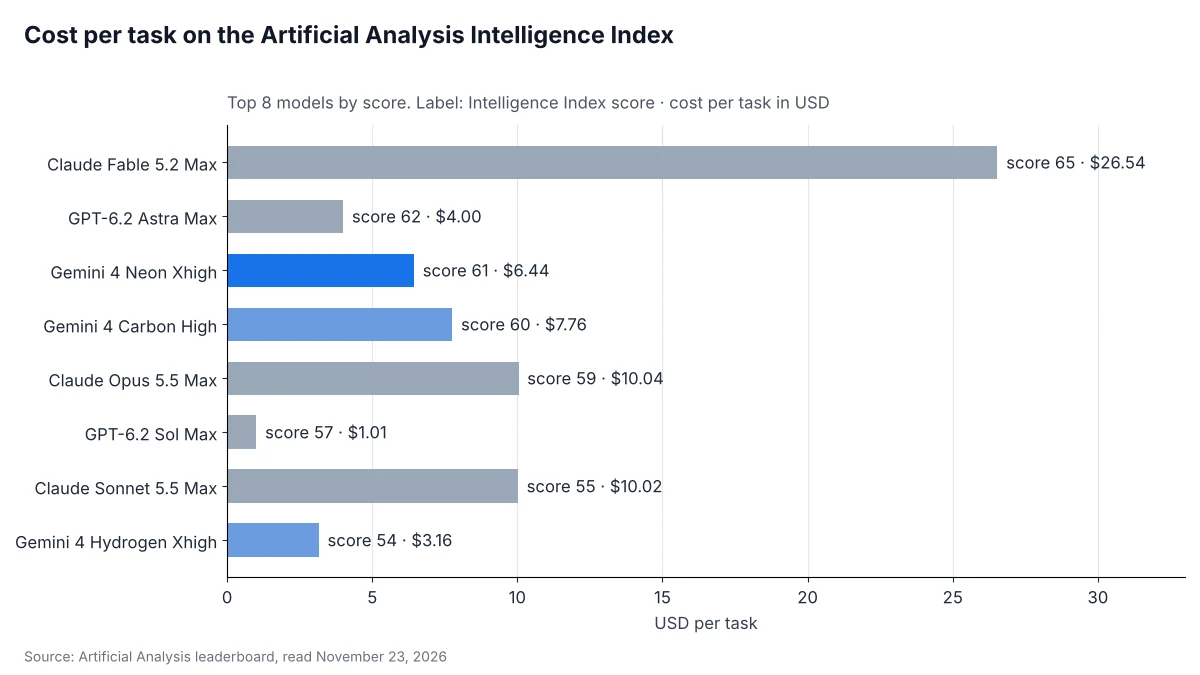
The chart is also the honest caveat. Neon is not the cheapest way to a top-three score: GPT-6.2 Astra at Max scores 62 for $4.00 a task and finishes in 14.1 minutes to Neon’s 23.8. GPT-6.2 Sol scores 57 for $1.01. If your agent work looks like this index, those two are hard to beat on price.
What Google says it is good at for business
The launch post leans on office and agent benchmarks rather than only coding. These are Google’s reported results; few of them have an independent rerun yet.
| Test | What it measures | Gemini 4 Neon (Google’s figures) |
|---|---|---|
| Zapier AutomationBench | Business automations across apps | #1 overall, 56.3% |
| Surge AI evaluations | Finance, accounting, spreadsheet modeling, complex constraints | #1 on most of them |
| Legal Research Bench · Tax Agent Bench | Legal and tax research | #1 on both |
| Andon Labs Vending-Bench 2 | Running a simulated vending business | #1, $16,843 |
| Chartography | Chart understanding | 73.5% |
| Agent Arena Index | Real-world agent sessions | #2, 1336 over 4,200+ sessions |
| Vals Index | Vals AI’s overall index | #2, 70.9% |
Google also ranks Neon #2 on Agent Arena for steerability, meaning it adapts when you correct it mid-task, and cites its lowest fabrication rate yet in internal Antigravity testing. Against Carbon, Google reports 43% to 56% less “under-service” (stopping short of the job) and 15% to 35% less “overreach” (doing more than asked), depending on effort level. For a business user, overreach is the one that matters: an agent that sends, deletes or edits more than you asked.
Where it falls short
It is slow to start. Artificial Analysis measured 58.32 seconds to the first answer token at Xhigh and 99 tokens a second after that. Fine for a report that runs on a schedule; noticeable in a chat.
There is no free tier. Testing it through the API means a paid project from the first call. Hydrogen is the free Gemini 4 option.
Most of the case is Google’s own numbers. The office benchmarks above are vendor-reported. The independent index puts it third, behind Claude Fable 5.2 and GPT-6.2 Astra, and more expensive per task than Astra.
Business availability is loosely defined. Google’s post says “Gemini for business” via the API or the model dropdown. Its subscriptions page lists Workspace with Gemini from $14 per seat a month and Gemini Enterprise from $30, but doesn’t say which Gemini 4 models each includes, so ask before you buy seats for Neon.
How to try it on a real task
The fastest test is one task your team already does every week, run on Neon and on the model you use now, with the same files. Here is a prompt for a finance or operations lead, written so any agent with file access can run it:
Read every CSV in the folder Finance/2026-10/ (bank export, card export, invoices).
Match each bank transaction to an invoice or card charge by amount and date (±3 days).
Make a spreadsheet Finance/2026-10/reconciliation.xlsx with three tabs:
1. Matched: date, amount, counterparty, invoice number.
2. Unmatched: every transaction with no match, and your best guess at why.
3. Summary: totals by category and the difference between bank and books.
Do not change or delete any source file. List any assumption you made at the top of the Summary tab.
Check three things: did it match the rows you would match, did it say what it assumed, and how long did it take. Run it twice; a good agent model gives the same answer both times.
Doing this in MegaBrain
MegaBrain is a desktop AI coworker for the Mac that works on the files in a folder you pick, writes documents, spreadsheets and decks, connects to tools such as Gmail, Google Drive, Slack, Notion, Jira and Airtable, and asks before risky steps such as sending, deleting or posting. Its paid plans include frontier models from Claude, GPT, Gemini and Grok up to a weekly limit, plus MegaBrain Core open models with a much larger one; Pro is $20 a month. The site names Gemini among the frontier models but does not list versions, so check the model picker for which Gemini models are there today. If you would rather not choose, Auto picks the strongest frontier model while your limits have room. The reconciliation prompt above runs as written on a folder, and you can put it on a schedule for the first working day of each month.
What this means for your team
Compare models per task, not per token. Neon is the clearest case yet: a 50% higher token price and a 17% lower task price than its bigger sibling. Run your own three most common tasks and count what each costs.
If you build on Gemini 4 Carbon through the API, look at Neon before December 1. Carbon’s Standard price doubles that day; Neon scores a point higher on the independent index for less per task.
Keep a cheaper model for bulk work. For summaries, sorting and first drafts, Hydrogen ($1.50 / $7.50 and a free tier) or GPT-6.2 Sol ($1.01 a task on the index) cost a fraction of Neon. Save the bigger model for judgement and long, multi-step jobs.
To run tasks like these on your own files with several labs’ models in one plan, download MegaBrain for Mac.
FAQ
What is Gemini 4 Neon?
Gemini 4 Neon is a Google model released on November 18, 2026, for software engineering, knowledge work and science. It sits between Gemini 4 Carbon, which Google keeps for the hardest long-horizon projects, and Gemini 4 Hydrogen, the fast everyday model. It has a 1 million token context window and four thinking levels.
Is Gemini 4 Neon free?
No. Google’s pricing page lists no free API tier for Neon: it costs $3 per million input tokens, $15 per million output tokens and $0.15 per million cached input tokens. In the Gemini app, Google’s launch post makes it available to Google AI Pro and Ultra subscribers. Of the three Gemini 4 models, only Hydrogen has a free API tier.
How much does Gemini 4 Neon cost?
On the paid Gemini API: $3 input, $15 output and $0.15 cached input per million tokens; half that on Batch and Flex ($1.50 / $7.50); $5.40 / $27 on Priority. In the Gemini app it comes with Google AI Pro at $19.99 a month or Ultra from $99.99 a month (US list prices on November 23, 2026). On the Artificial Analysis Intelligence Index it costs $6.44 per task at its highest thinking level.
Gemini 4 Neon vs Gemini 4 Carbon: which is cheaper?
Per token, Carbon is cheaper until November 30 ($2 / $10 to Neon’s $3 / $15); from December 1, Carbon goes to $4 / $20 and Neon becomes 25% cheaper per token. Per task, Neon is already cheaper: Artificial Analysis measured $6.44 a task for Neon at Xhigh to $7.76 for Carbon at High, with a score of 61 to 60. Google says Neon costs 32% less per task than Carbon at the default high setting.
Gemini 4 Neon vs GPT-6.2 Astra?
On the Artificial Analysis leaderboard read on November 23, 2026, GPT-6.2 Astra at Max scores 62 for $4.00 a task and 14.1 minutes; Gemini 4 Neon at Xhigh scores 61 for $6.44 and 23.8 minutes. GPT-6.2 Sol at Max scores 57 for $1.01. On that index Neon is not the cheapest route to a top score; Google’s own office-work results (Zapier AutomationBench, Surge AI’s finance and spreadsheet tests) are the case for it.
Is Gemini 4 Neon safe for company data?
Google says Neon carries Gemini 4 Carbon-level protections against misuse and prompt injection, reports 0.0% attack success on Gray Swan’s indirect prompt injection benchmark at the highest thinking level and a 0.09% misaligned action rate on its agentic safety suite. Those are Google’s own figures. How your data is handled depends on the product and contract you use it through, so check the terms of the Gemini plan or API tier your company signs up for.
Sources
Pages opened November 23, 2026. Every number above comes from these pages, or from our arithmetic on them where we say so (percent differences between listed prices and costs per task).
- Google — Introducing Gemini 4 Neon, by Koray Kavukcuoglu (November 18, 2026): positioning, prices, availability, benchmarks, safety results
- Google AI Studio — Gemini API pricing (Standard, Batch, Flex and Priority prices for Gemini 4 Neon, Carbon and Hydrogen; Carbon’s December 1 change)
- Google — Gemini subscriptions (Google AI Plus, Pro and Ultra; Workspace and Gemini Enterprise starting prices)
- Artificial Analysis — model leaderboard (Intelligence Index score, cost per task, time per task)
- Artificial Analysis — Gemini 4 Neon model page (output speed, time to first token)
- Artificial Analysis — Gemini 4 Carbon model page
Full disclosure: MegaBrain makes a desktop AI coworker for business that runs on models from labs including Google, Anthropic and OpenAI. MegaBrain is not affiliated with Google, Anthropic, OpenAI, Artificial Analysis, Zapier, Surge AI, Andon Labs, Vals AI or Gray Swan.
MegaBrain for Mac · an AI coworker
Give MegaBrain the task, not the steps.
It works on your files, writes documents, spreadsheets and decks, connects to your team’s tools and asks before anything risky. Free to start.
Newsletter
Stay in the loop
Get our latest AI research and guides. No spam, unsubscribe anytime.